著者:Alvin H. Bantiquete, Tetsuo Yamada, Yui Ichikawa, Hiroyuki Sudo, Takeshi Tomiyama
題目:Trophic interaction, niche overlap, and species-specific feeding responses of juvenile pleuronectid flatfishes after emigration from nursery grounds in Suo-Nada, western Seto Inland Sea, Japan
掲載誌:Regional Studies in Marine Science 94: 104761 (2026)
カレイ科魚類が成育場移出後にどのような食物利用と種間関係にあるかを調べた論文です。2023年後期から博士課程後期で研究している留学生のAlvinさんが学位論文の一部として取り組み、執筆、投稿を行いました。
This paper examines how pleuronectid flatfish species utilize food resources and interact with each other after leaving their nursery grounds. The study was conducted, written, and submitted by Alvin, an international student (enrolled since October 2023), as part of his doctoral dissertation.
沿岸性のカレイ科魚類(ここではマコガレイ、イシガレイ、メイタガレイ)は浅場を稚魚期の成育場として利用し、初夏になる前に沖合の深場へと移動します。国内外を問わず、多くのカレイ科魚類で成育場における稚魚の食物利用や成長について研究が行われてきた一方で、成育場から沖合へと移動した後の生態はほとんどわかっていません。これは、単純に沖合へ移出すると分散によって生息密度が低くなり、採集することが困難になるためです。
山口県山陽小野田市の沖では、水産研究・教育機構の山田さんが中心となって、ヒラメ・カレイ類の調査が行われています。特にマコガレイ、イシガレイは浅場の成育場で2~4月に採集されますが、5月になるとほとんど採集されることがなくなります。一方、その沖合で小型底びき網を操業する漁業者によると、ヒラメ・カレイ類の稚魚が5月以降に網に入ることがあるそうです。そこで、漁業者にこれらの採集をお願いし、2023年に1,500尾以上のカレイ科魚類サンプルを得ることができました。採集された稚魚は、成育場から移出してきた(小型底びき網の漁場に移入してきた)ものと考えられます。
Alvinさんはそれらの胃内容物や肥満度(栄養状態の指標)を調べました。その結果、3種のカレイ科魚類は沖合では主に多毛類を摂食していること、7月までは採集されるが、8月以降は採集されないこと(水温が高くなるため、さらに深場へ移出していると考えられます)、メイタガレイでは5~7月にかけて肥満度が上昇するものの、マコガレイやイシガレイでは7月に肥満度が低下することがわかりました。胃内容物の量もメイタガレイでは季節の進行とともに増加傾向にあったものの、マコガレイとイシガレイでは7月に低下していました。以上のことから、魚種によって成育場移出後の特性がやや異なるものの、共通した場所で似たような食物を利用していることが明らかとなりました。
Coastal flatfish belonging to the flounder family, such as marbled flounder (Pseudopleuronectes yokohamae), stone flounder (Platichthys bicoloratus), and ridged-eye flounder (Pleuronichthys lighti), spend their juvenile stage in shallow coastal waters, which serve as important nursery grounds. Before early summer, they move from these shallow areas to deeper offshore waters. Many studies, both in Japan and overseas, have focused on how juvenile flatfish feed and grow in nursery grounds. However, what happens to them after they leave these nursery areas and move offshore has remained largely unknown. This is mainly because, once they move offshore, the fish spread out over a wider area, making them much harder to catch and study.
Offshore of Sanyo-Onoda City in Yamaguchi Prefecture, surveys on flounder species have been carried out under the leadership of Dr. Yamada at the Japan Fisheries Research and Education Agency. Juvenile marbled flounder and stone flounder are commonly found in shallow nursery areas from February to April, but they almost disappear there after May. On the other hand, local fishermen who operate small bottom trawl fishery offshore report that flatfish juveniles are sometimes caught in their nets from May onward. Based on this information, we asked fishermen to help collect these fish, and in 2023 we obtained over 1,500 individuals of pleuronectid flatfishes. These juvenile fish are thought to have moved out of nursery grounds and into the offshore fishing areas.
Alvin analyzed what these fish were eating by examining their stomach contents, as well as their body condition, which is an indicator of nutritional status. The results showed that all three flatfish species mainly fed on polychaete worms living in the seabed after moving offshore. The fish were found in offshore catches until July, but not after August, likely because rising water temperatures caused them to move further into deeper waters. In the ridged-eye flounder, body condition improved from May to July. In contrast, the marbled flounder and stone flounder showed a decline in body condition in July. A similar pattern was observed in the amount of food found in their stomachs: it increased over the season in the ridged-eye flounder, but decreased in July in the other two species. Overall, the study shows that while each species responds slightly differently after leaving the nursery grounds, they gather in similar offshore areas and rely on similar food resources during this stage of their life.
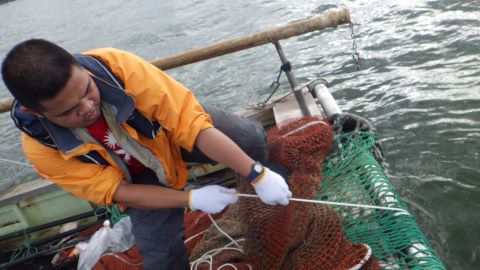
(小型底びき網漁場で採泥をするAlvinさん)
Alvin pulling a grab sampler at the offshore fishing ground.
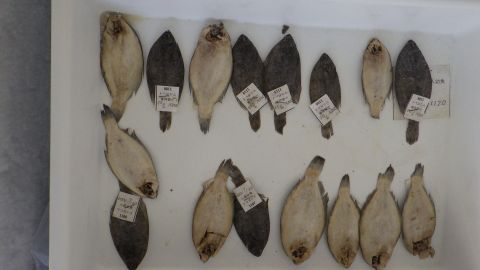
(漁場で採集されたマコガレイ稚魚)
Juvenile marbled flounder collected from the fishing ground.
以上の結果をもとに、Alvinさんが論文原稿を執筆し、2025年6月に初稿を仕上げました。それから推敲を重ね、Alvinさんが責任著者として2025年10月にRegional Studies in Marine Scienceに投稿しました。11月末にMajor revisionの判定の審査結果が届きました。12月に修正原稿を投稿し、2026年1月上旬に微修正の指示を受けて対応し、1月6日に受理されました。そして、ゲラ校正を経て1月13日にオンライン掲載されました。広島大学と出版社との転換契約により、オープンアクセスで出版されました。
Based on these findings, Alvin prepared a manuscript describing the study and completed the first draft in June 2025. After several rounds of careful editing, the manuscript was submitted to the scientific journal Regional Studies in Marine Science in October 2025, with Alvin serving as the corresponding author. At the end of November 2025, the reviewers' comments were returned with a decision of "major revision," meaning that substantial revisions were required. Alvin revised the manuscript accordingly and resubmitted it in December. In early January 2026, he received a request for minor revisions, which were promptly addressed, and the paper was officially accepted on January 6, 2026. Following the proofreading process, the paper was published online on January 13, 2026. Thanks to the transformative agreement between Hiroshima University and the publisher, the paper was made available as an open‑access publication, allowing anyone to read it freely.
